Showing posts with label Christmas 1. Show all posts

Saturday, December 28, 2019

Year A, Christmas 1, Hebrews 2.10-18 Jesus


Grace to you and peace from God our Father and our Lord and Savior, Jesus the Christ.  Amen
“So what you preach on today, Dad?  Jesus?”
I don’t know how many times I’ve heard that from my kids on a Sunday afternoon.  It’s a safe bet.  Even when I don’t mention Jesus by name, to speak about God’s word is to speak about Jesus as the Word, and so he’s always the subject.
And if the sermon has anything to do with what God is doing, and I’d like to believe every sermon I preach does, it’s also then about what Jesus is doing, for he and the Father are one.
On Christmas Eve I explored Mary’s question, “How can this be?”, and shared that I believe the biggest miracle of all in the Christmas story is that through Jesus, that baby lying in a manger full of grace, God could bring salvation to all.  To all.  Not just to some, but to all.  A gift freely given.
If the question on Christmas was “How?” the question today, based on the Hebrews text, is “Why?”  “Why did he come? And What did he do?”
In answering the “Why?” and the “What?” of Jesus life the Church, the Bible, and Christian teaching has focused on three different  dimensions of Jesus’ life and work.
Each of these understandings is very different from the other, yet all of them speak to the truth of who Jesus is.  There’s not one right answer, but many right answers because each of them employs human analogies, none of which are sufficient to convey the mystery of God in Jesus.
And so, from three different directions, each image sheds light on Jesus, even if only partially.
They also work off each other as correctives.  By having three different understanding of the “Why?” and the “What?” of Jesus life it helps to prevent us from pushing any of these images too far. 
The three understands of Jesus are all present in the passage from Hebrews.  They are:
Jesus, our Brother.
Jesus, our Savior.
And finally, Jesus, Lamb of God.  That is, Jesus the sacrificial lamb that died to take away our sin.
Jesus, our Brother:
“10It was fitting that God, for whom and through whom all things exist, in bringing many children to glory, should make the pioneer of their salvation perfect through sufferings. 11For the one who sanctifies and those who are sanctified all have one Father. For this reason Jesus is not ashamed to call them brothers and sisters, 12saying, “I will proclaim your name to my brothers and sisters, in the midst of the congregation I will praise you.” 13And again, “I will put my trust in him.” And again, “Here am I and the children whom God has given me.” 14Since, therefore, the children share flesh and blood, he himself likewise shared the same things,  .  .  .”
Jesus, our Savior:
“so that through death he might destroy the one who has the power of death, that is, the devil, 15and free those who all their lives were held in slavery by the fear of death. 16For it is clear that he did not come to help angels, but the descendants of Abraham.”
And finally, Jesus the sacrificial lamb:
“Therefore he had to become like his brothers and sisters in every respect, so that he might be a merciful and faithful high priest in the service of God, to make a sacrifice of atonement for the sins of the people. 18Because he himself was tested by what he suffered, he is able to help those who are being tested.”
And of course we know that when we speak of Jesus making the sacrifice of atonement, he speaks of the sacrifice of his own life.

When we speak of Jesus as our brother, and God as our Father, we are in a relational model, a family model, and the end game is an intimate oneness between all of us.
The ‘evil’ in this relationship model is separation and estrangement from God as our Father, and Jesus our brother, and also all our other brothers and sisters.
When we speak of Jesus as our Savior, the evil of which we are concerned is an evil that is beyond ourself.  It is an enemy that threatens to undo us.  It is that evil power that must be defeated, whether we speak of it as the devil or death itself.  The end game here is that we are freed from our bondage and slavery to these evil powers.
And finally, when we speak about Jesus as the sacrificial lamb, we speak of evil as the sin within us that must be atoned for.  Our guilt and shame are the problem.  Jesus offers himself as a sacrifice to atone for our sins and achieve forgiveness for us.
Well, what is true?
The answer is that all of these understandings are true, even though quite different.
Well, what is most helpful?
That depends on your situation in life.
If you feel lonely and afraid, like an outsider, then Jesus as your brother who reconciles you to your Father in Heaven and your brothers and sisters on earth will ring especially true and helpful.
If you feel under attack from evil beyond yourselves, including every form of earthly evil including our own mortality and death, as well as evil powers and principalities, then Jesus as our Savior will bring great comfort to you.
And if you are overwhelmed with your own failures, the Jesus the atoning sacrifice for your sin will bring you peace of mind and wellness.

We see all of these situations in life expressed in the Gospel lesson for today that speaks about Mary and Joseph fleeing into Egypt following Jesus’ birth.
When they were refugees who sought asylum in Egypt they experienced isolation from their family as they waited for the time when they might return home, once again. 
Both they and the people of Bethlehem were victims of the oppressive and evil reign of Herod, who sought to kill Jesus and did murder all those children in Bethlehem.
And finally Herod was guilty of a great sin and needed forgiveness.

In speaking of these three dimensions of Christ’s work, it is important to remember that whether we speak of Christ as our brother, or savior, or as the One who died for us, we are speaking of what Jesus did, not us.
It’s all about Jesus.
We talk about the Law and the Gospel.
When we speak about the Law, it is always about what we do or fail to do, and the judgment that results.  And rather than being found righteous, we will always fall short.  We stand condemned in the face of the Law.
On the other hand, when we speak of the Gospel it is always about what Jesus has done and Jesus did not fail.  That’s what makes the Gospel good news.
And finally, because the Gospel is and always will be the work of Christ, not us, we do not get to judge.  Period.  It’s above our pay grade.
We don’t get to judge who Jesus reconciled to the Father.
We don’t get to judge who Jesus set free from the power of evil.
And we don’t get to judge to whom Jesus offered forgiveness.
You see, all these things are the work of Jesus; it’s why he came and what he did.  For us to judge one another is for us to judge Jesus himself.
Let’s just pause and let that sink in.
If I ever say that you, or anyone else including myself, are not saved, I am judging Jesus as a failure.
I am judging Jesus.
That’s not something I’m qualified to do.
What we are called to do is not judge Jesus, but to proclaim Jesus and the work that he does.
Jesus reconciles us with God and one another.
Jesus defeats evil.
Jesus atones for our sin.
In the end, any judgment belongs exclusively to Jesus, not us.  Exclusively.
And should we ever fear that judgment, we need only remember that the judge, Jesus, is also the one who came to save us.
Amen

Saturday, December 29, 2018

Becoming Obedient, Year C, Christmas 1, Luke 2.41-52, Colossians 3.12-17


Grace to you and peace from God our Father and our Lord and Savior, Jesus the Christ.  Amen
 Christ was born in Bethlehem.
Now, he had to grow up.
We know little of his childhood, though stories abound.  One of the sources of some incredible, meaning, unbelievable stories about Jesus the child, come from the Infancy Gospel of Thomas.
The first example:
  1 1 When the boy Jesus was five years old, he was playing at the ford of a rushing stream. And he gathered the disturbed water into pools and made them pure and excellent, commanding them by the character of his word alone and not by means of a deed.
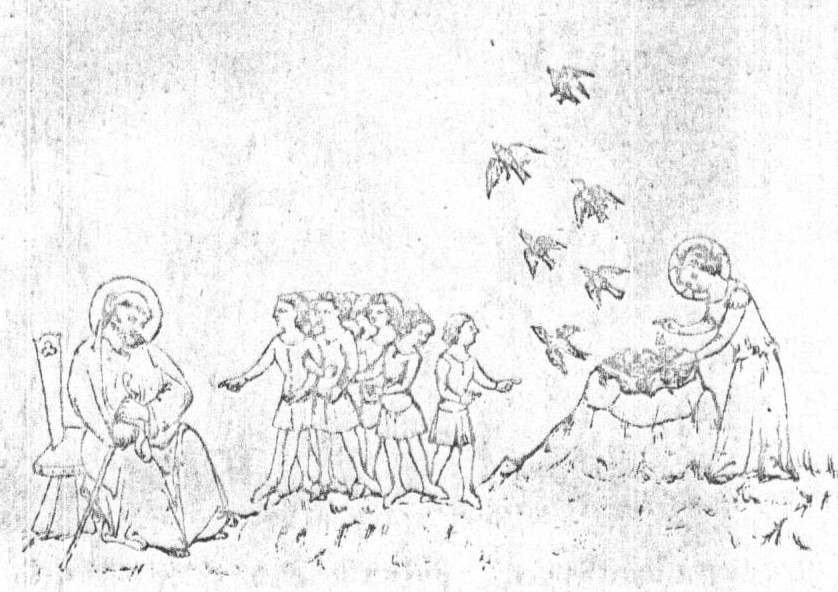
  2 Then, taking soft clay from the mud, he formed twelve sparrows. It was the Sabbath when he did these things, and many children were with him.
  3 And a certain Jew, seeing the boy Jesus with the other children doing these things, went to his father Joseph and falsely accused the boy Jesus, saying that, on the Sabbath he made clay, which is not lawful, and fashioned twelve sparrows.
  4 And Joseph came and rebuked him, saying, “Why are you doing these things on the Sabbath?” But Jesus, clapping his hands, commanded the birds with a shout in front of everyone and said, “Go, take flight, and remember me, living ones.” And the sparrows, taking flight, went away squawking.
  5 When the Pharisee saw this he was amazed and reported it to all his friends.
Some of the stories are horrible, suggesting that the young boy Jesus would curse people and they would die.
But then others present a more pleasing side to Jesus:
8 1 And again, after many days, Jesus was playing with other children on a certain roof of an upstairs room. And one of the children fell and died. The other children, seeing this, went to their homes. And they left Jesus alone.
  2 The parents of the dead child came and accused Jesus saying, “You knocked down our child.” But Jesus said, “I did not knock him down.”
  3 And while they were raging and shouting, Jesus came down from the roof and stood beside the body and cried out in a loud voice saying, “Zeno, Zeno—for this was his name—rise and say if I knocked you down.” And he rose and said, “No, Lord.” When they saw, they were amazed and the parents of the child praised God for these wonders.
Another story is one of my favorites:
 11 1 And he was about eight years old. And when his father, a carpenter, was making ploughs and yokes, he received a bed from a certain rich man so that he might make it exceedingly great and suitable. And since one of the required pieces was shorter and he did not have a measure, Joseph was distressed, not knowing what to do. The boy came to his father and said, “Put down the two pieces of wood and align them from your end.”
  2 Joseph did just as Jesus said to him. And the boy stood at the other end and took hold of the short piece of wood and stretched it. And he made it equal to the other piece of wood. And he said to his father, “Do not be distressed but do what you wish.” And Joseph embraced and kissed him saying, “Blessed am I for God gave me this boy.”
(Quotations are from The Childhood of the Saviour (Infancy Gospel of Thomas): A New Translation, Translation copyright 2009 Tony Burke. All rights reserved.)
The last story in the collection, is the story of Jesus staying behind in Jerusalem which we read in today’s Gospel.
It’s actually the only Biblical account of Jesus’ life from his birth until he began his ministry many years later.
There are other stories.  For example the Koran, the Holy Book of Islam has its own account of Jesus’ birth:
The Birth of Jesus
“So she conceived him, and she withdrew with him to a remote place.  And the pains of childbirth drove her to the trunk of a palm tree.  She said, ‘I wish I had died before this, and had been long forgotten.  [Mary was worried that people would think badly of her as she was not married.]  Then (baby Jesus) called her from below her, saying, ‘Don’t be sad.  Your Lord has provided a stream under you.’  Shake the trunk of the palm tree towards you, and it will drop on you fresh ripe dates.  So eat and drink and be happy.  And if you see any human, then say, ‘Indeed I have vowed a fast to the Most Merciful so I will not speak to any human today.’  Then she carried him and brought him to her people.  They said, ‘O Mary, indeed you have done a great evil.’  ‘O sister of Aaron, your father was not an evil man, and your mother was not a fornicator.’  So she pointed to him.  They said, ‘How can we speak to a child in the cradle?’  (Jesus) said, ‘Indeed, I am a slave of God.  He has given me the Scripture and made me a prophet.[4]  And He has made me blessed wherever I may be, and He has enjoined on me prayer and charity as long as I remain alive.  And (has made) me kind to my mother, and did not make me arrogant or miserable.  And peace be upon me the day I was born, and the day I will die, and the day I will be raised alive.’” (Quran 19:22-33)  (
Just to note, Muslims believe Jesus was a great prophet, and they ascribe to him a miraculous birth, with him being able to speak from the first day, but they absolutely do not believe that his virgin birth or special powers made him God.
It’s no wonder that some early authors sought to fill in the void with stories about his childhood.  Yet most of them appear fanciful, and in fact, are preoccupied with Jesus’ divinity.
You see, it all boils down to this:
The single greatest offense of the Christian faith, the one that separates us from all other faiths, and the offense that stands counter to ALL reason, is that God could humble himself and become fully human, subject even unto death.
The second offense is related to that, and that is that God would do this in order to reach out to us in love.
Fully human.
Mary, not the angels, had to change his diapers.
She nursed him at her breast.
Joseph and Mary rejoiced when he learned to walk.
He would have to learn to speak.
Undoubtedly, he got colds and other childhood illnesses.
He studied.
He learned.
Probably he learned his father’s trade, and was skilled as a carpenter, though nothing is said about that.
He might also have misbehaved.
Which brings us back to Jerusalem, and Mary and Joseph’s worst nighmare.  Losing Jesus.
First of all, in Mary and Joseph’s defense, “it takes a village to raise a child.”  What I mean by that is that often, in communities such as theirs, children moved in and about the community and were with their neighbors and relatives as much as their parents.
I had the opportunity to grow up in one such town.  I asked my parents if I go could home to the farm of one of my friends after church.  I went.  I stayed because I was having so much fun.  Finally, on the next Saturday, my father came out to the farm and got me.  “Why didn’t you come home?”  “I was having fun.”
So, anyway, for Mary and Joseph to assume Jesus was somewhere with their friends and relatives would have been common.
Instead Jesus was present in the temple, talking with the teachers. 
Some of the apocryphal stories of Jesus childhood suggest that he always turned the tables and taught his teachers. 
But I’d suggest that instead of something miraculous occurring this is just an example of Jesus’ hungering for knowledge and wisdom.
At any rate, Jesus’ behavior concerned his parents.  They were alarmed, afraid of what might have happened to him, and perhaps even angry with him once they found him.
Jesus then, returned to Nazareth with them and obeyed them.
Obedience is one of the things we learn as we grow.
This is the one story about Jesus’s boyhood that is included in the bible, and it is a story about learning to obey.
On Christmas Eve, I shared the passage from Philippians 2:
And being found in human form,
he humbled himself
and became obedient to the point of death—
even death on a cross.
Jesus, God incarnate, becoming obedient.
Obedience is not the first word most of us would use to describe Jesus.
Yet it was Jesus willingness to submit to the Father’s will that allowed him to become our Savior.
In our lesson today, Paul writes:
12As God’s chosen ones, holy and beloved, clothe yourselves with compassion, kindness, humility, meekness, and patience. 13Bear with one another and, if anyone has a complaint against another, forgive each other; just as the Lord has forgiven you, so you also must forgive. 14Above all, clothe yourselves with love, which binds everything together in perfect harmony. 15And let the peace of Christ rule in your hearts, to which indeed you were called in the one body.
Bear with one another.
Forgive one another.
Love one another.
Be at peace.
This is the Way of Jesus.
And to walk with Jesus is to be obedient as Jesus was.
I’m suggesting to you, that just as the boy Jesus had to learn obedience, so also, our growth in faith is about learning to obey.
But this obedience is not one offered out of fear of punishment, but rather out of love.
Amen

Saturday, December 30, 2017

Christmas 1, 2017, Galatians 4:4-7, Luke 2:22-40 Adoption, a Goodbye and Hello

Grace to you and peace from God our Father and our Lord and Savior, Jesus the Christ.  Amen
One of my bishops and his wife served as foster parents for children to be adopted, specifically for infants.  They worked with Lutheran Community Services which at that time did a lot of work with adoptions.
Their role was to care for the child during the period of transition between birth and placement in the adoptive parent’s home.
As they reflected on this ministry of theirs, there were two extremely moving moments.
The first would occur in the hospital.
A mother, the birth mom, one who so deeply loved her child that she chose to carry it till birth as opposed to having an abortion, would for the sake of the child, give that child up and hand her baby over to Mark and Carol.
Often these birth mothers were young, barely old enough to have a child, and hardly old enough to care for the child.
Each one had their own reasons for offering their child for adoption.
But one thing was true of all of them, and that was a love for the child so deep that for the child’s sake they would make that gift.
After a time of visiting there would come the moment when it was time.
Mark related one such experience when at the entry to the hospital, the young mother handed the baby over to them, got in her parent’s car, and as they drove away, with tears in her eyes, she simply waved goodbye.

Mark and Carol would then take the baby home with them, care for the child as though it were their own, until the time came to deliver it to the adoptive parents.
This would occur a few days or weeks later, and for them brought some mixed emotions as well.
Now they had to give up the child.
But they had the great joy of witnessing this gift to the adoptive mom and dad.
Often the adoptive parents had been yearning and praying for a child for years and now was the moment that those prayers were answered.
When you’ve had the privilege of giving birth to a child, it’s hard to imagine a joy greater than that of welcoming your child into the world.
And yet, I believe, that for the adoptive parents the joy may be even more profound than for the birthparents, for  the adoptive parents are often in a position of wondering, even grieving, their own inability to have a child—and then, as a  pure gift, they receive a child.

Adoption.
A giving and receiving.
Letting go, and embracing.
A birthparent’s sacrifice.
An adoptive parents’ great joy.

There’s one other experience we should take note of regarding adoption.  Because adoption so often takes place following birth we often don’t think about it, but we should.
That is the experience of the child.
There is a bonding between a child and their parents, a bonding that begins in the womb, is nurtured at the breast, and only gets greater with each passing day. 
For an older child that is adopted, there can be an incredible grief associated with this process.
And even for an infant, there will come a day when they realize that their birth parents gave them up, and that knowledge will bring with it a quagmire of emotions.
Yet in contrast to that is the awareness that their adoptive parents had opened their hearts to them in a most profound way.

What is the point of all this, and why is adoption one of the images that is used to describe our experience of faith?
Good question.
I have to tell you that when I speak to people about the meaning of baptism, the image of adoption has not been one of my favorite images.
My problem is that I find myself debating who the true birth parent is, and who the adoptive parent is.  When used with respect to baptism, the understanding is that God adopts us as his child.
And yet part of me wants to insist, that because God is our creator, God is our true birthparent as well.
In this way, I’d say that our earthly parents are actually foster parents, entrusted with the care of a child that is not their own.
Well, that’s one bias of mine.

But when the Bible speaks of our adoption as children of God, it bears witness to another reality.
There is a profound change in our identity, our relationships, and our life.
There is a letting go, and a latching on.
There is a grief experienced regarding the old, and a joy experienced regarding the new.
It’s an image of death and resurrection.
We have two natures.
We are both children of this world, and through our baptism into Christ, children of God.
When Paul speaks about our status as children of the world, he uses the image of a slave.
Our lives are defined by our actions, we are what we do, and in that each of us is by nature sinful, we are sinners.  Slaves under the law.  Defined by our own disobedience. 
I participated in a parenting workshop once, put on by Lutheran Community Services, in which the presenters made the point that the primary work of an adolescent child was differentiation. 
What they meant by that was that a child would, by nature, differentiate themselves from their parent, often through their disobedience, and doing things their own way.
And perhaps that is true of our relationship with God, as well.  We sin in part, to differentiate ourselves from God and establish our own identity. 
But then something happens as we live out our baptisms in daily life.
We are no longer defined by our disobedience, but by our relationship with God as our Father and Jesus as our Brother.
We are children, adopted by God through our baptism into Christ Jesus, and defined no longer by our own actions, but by the love of God, and Christ’s own sacrifice.
But this new reality doesn’t just happen.
It comes with a fight.
Our old self must die in order for our new self to be born.
We have a lot invested in our old self, so we generally do not jump at the opportunity for the new life that is ours in Christ Jesus.
Even if we acknowledge that our old self is defined by our sins, we struggle to let go of it, because, quite frankly, we chose those sins.  Sinful yes, but hey, they are my sins and my identity.
In my own life, two things stand out.  I built a personal identity around two things that are both destructive to me, and I would say sinful because of that, but they became part of who I am.
For many years, a significant part of my identity was that I was a Scotch drinker, and a smoker.
I have been set free from one of those, I am still struggling with the other.  Part of the reason breaking free of such addictions is so difficult is that we have to give up part of our own identity. 
There are other aspects of our identity as sinners that are more difficult than physical addictions.  The reason they are so difficult is that we don’t understand or appreciate them as sinful, nor do we realize how powerless we are at overcoming them. 
If one is an alcoholic, or a smoker, you probably realize, at least I did, that this is not a good thing.
But there are other things that masquerade as being good, which in fact are part of our sinful nature.
Freedom, for example. 
What do we value more in this country than freedom?
We have a national identity built around being the leaders of the free world, as opposed to other nations whom we see and understand to be living in bondage.
Freedom.  A good thing, we would say.  One of the things we value more than anything else.
Are we called to be free to live according to our own will?
Or are we called to be obedient to the will of God?
In order to embrace one of those identities we must give up the other.  To claim Jesus Christ as our Lord and Savior is to no longer be free, but rather to be bound to the one who loves us.
Another part of our old self is the notion that we are what we have.  We are a materialistic society.  Our homes, our cars, our furniture, our clothes, and, yes, certainly our vast array of toys, define and shape our very identity.
This is never clearer than when fire or flood destroys everything we have accumulated.
Are material possessions a blessing of God or a curse under which we live?  Do our possessions set us free or bind us? 
There are many more examples we might cite.
But the point is this:  That in order to enjoy the new life that is ours in Christ Jesus, there will be a grieving over the old life that we must let go of. 
Everything comes at a cost, there are no free lunches.
To be a child of God means that we no longer children of this world. 
The old self dies that the new self might arise.
What does being a child of God entail?
Jesus says: “You shall love the Lord your God with all your heart, and with all your soul, and with all your mind.”
To love the Lord our God with ALL our heart, soul, and mind, means that we must give up our love for much of what has previously defined us.
Now is when I’m supposed to say: “This new life in Christ will be great.”  That’s true.
But the truth is, it will also be hard.

Amen